Saturday, September 3, 2011

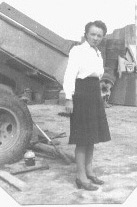
Teen Myrna

Howard, Myrna and Grandpa Pitts

Myrna, Laurel and Charlotte in Front of Grandma Smith's House

Friday, September 2, 2011

Building Bridges--Some of Howard Pitts' Construction Projects

Working on the Bridge

A 1949 Bridge Project

Building Bridges

Grandpa Pitts and Workers

Charlotte at Bridge Building Site

One of the Bridges Dad Built

Visiting the Bridge

Some of the Workers

Friends at Construction Site

At Construction Site

At the Pitts Farm/Pitts Brothers Shop in Carbonville

Ruth Edwards Pitts at Farm/Shop


Uncle Ken, Grandma Smith, Uncle Bob, Grandma Pitts, Grandpa Pitts and Myrna

The Farm Part of the Property

Dad and Myrna at Farm/Shop

Grandma Pitts, Aunt Pat and Myrna

Uncle Bob and Myrna

Thursday, September 1, 2011

Some World War II Photos of Howard Thomas Pitts

Loading to move to another location.
Navy Winter Uniform.

The Enola Gay seen through a cracked and battle-scarred windshield.

Dump trucks loading road base.

That same scarred windshield reveals a tank.


It was steamy and hot,

Winter Uniform in Price, UT

Summer Uniform--R&R Hawaii

Enola Gay

He Sometimes Watched Strafing 


Ruins

Always Building

Buddies

More Seabees


Getting Road Base

Ready for Battle

Building 

Add caption


Camouflaged 

Seabee Buddies

Seabees Built Airstrips for Bombers

Another Photo of Dad

More War Buddies

Fighting the Japanese

War Buddy

The Enola Gay, in another view.


Dad, his mom, Ruth Edwards Pitts and his father, Vivan Pitts 

Tuesday, August 16, 2011

Neighbor Kids


One day, when I was a pre-schooler, my next-door neighbor friend, Frank Ruzzuto, who was near my age, was playing with the rest of the neighborhood gang and my boy cousins.
The cousins would, most likely have just been Garth and David. Cousin David was just a baby and Richard was not born until I was 11.
At any rate, Frank decided that he would pretend to be the father and would go to the store in the family car. The car was sitting in front of his house and, of course, was unlocked. (I don’t think people locked anything back then. At least, none of the people I knew did.)
I climbed into the front seat on the passenger side. I was always the gullible one. 
Frankie, whether on purpose or by accident, did something to the shifting column that allowed the car to move forward. 
We lived on the south side of Carbon Avenue in Price, Utah, at the time. The roadway sloped towards the end of town. Of course, we started rolling, gaining momentum as we went. 
I don’t know, to this day, whether Cousin Garth, a couple of years younger than I, just screamed or whether he actually ran to get Aunt Renee. Perhaps it was neither and the noise of the other neighborhood kids alerted her or, perhaps, knowing how children behave, she just looked out the window to check on us, 
Whatever caused her to know about the danger, she responded. She came running alongside the car, jerked the door open, slammed on the brake and slid behind the wheel of the car in what seemed one fluid motion.
Thankfully, the car stopped. She then moved it back to the side of the street and got the two of us out. 
Mrs. Ruzzuto claimed Frank and I was taken into my own house. I was scolded, told never to get in a car without an adult inside ever again and had to sit in the corner for what seemed like forever. 
Needless to say, I didn’t ever quite trust Frank again. I did, however, trust his sister, Mary, and his little brother. 
Still, with all that, Frank and Mary managed to cause trouble for all of us once again. 
We used to love to eat Jell-O powder. We would get a package from one of our parents and would open it and pour a bit into one hand. Then we would lick it off and repeat the process until the Jell-O was gone. It was easy to share a package. You just poured some into your friend’s hand and they licked it away.
One day, when we were all outside playing together, Mary and Frank came outside with orange-flavored Jell-O. It was a bit lighter in color than the usual orange we were used to but not enough to really attract special attention.
After we consumed the Jell-O, we all found out that what we had really eaten was permanent wave powder.
My goodness! We all had excited adults at that point. 
It seems that Frank and Mary climbed up into the cupboard and got what they thought was Jell-O. The lesson: always let an adult get the treat down. Don’t be sneaky.
Dr. John Frank Colombo, the family doctor of most of us, was called and each of us had to drink lots of milk. That was usually fine, we all liked milk, but in this case it was punishment and all of us were unhappy and unwilling. It must have worked, however, because we all lived.

Monday, July 11, 2011

Were You There, Charlie?

When I was small and would seem to be bragging and stretching the truth, my grandmother would say: “Were you there, Charlie?”
My grandmother was born in 1894 so a lot of the stories and quotes she used were from a time two generations before I showed up on the scene. She told me that the saying came from an old radio program but she didn’t ever say which one. She said that the star of the show would tell impossible stories and, when questioned, would say: “Were you there, Charlie?”
I decided to look up the old saying after I ran across a story using it. It was a news story discussing the closure of the GM  Janesville, Wisconsin, plant as written By Charlie LeDuff and Danny Wilcox Frazier. The teaser for the article included the words: “Were you there Charlie?" 
It turns out that the saying was the creation of radio comic, Jack Pearl. In the show, the Baron Munchausen, Pearl’s creation, was a braggart whose wild anecdotes, uttered with a Jewish/”Mittle European” accent testified to his unlikely acts. The Baron character was loosely based on the real Baron Münchhausen, a teller of tall tales.
Karl Friedrich Hieronymus, Freiherr von Münchhausen, who lived in the 1700s, was known as Baron Münchausen in English. He was a German nobleman born in Bodenwerder and became famous for his tall tales.
The real Baron served in the Russian military and was a soldier in two campaigns against the Ottoman Turks. When he returned home, Münchhausen, according to contemporary reports, told some outrageously farfetched stories about his adventures. For example, the Baron's astounding feats included riding cannonballs, traveling to the Moon, and escaping from a swamp by pulling himself up by his own hair. In some versions, he reportedly said he had pulled himself up by his own bootstraps.
Pearl’s Baron always addressed skepticism with a catchphrase that once was as familiar to Americans as "Whatchu talkin' 'bout, Willis?" is today. Uttered as: “Vas you dere, Sharlie?” The phrase translated to: "Were you there, Charlie?"
When the straight man (originally Ben Bard, but later Cliff Hall), expressed doubt about the story being told, the Baron replied: "Vass you dere, Sharlie?" His coined catch phrase soon became part of the national vocabulary.
Jack Pearl (Jack Perlman) was born on October 29, 1894, in New York City, and died on December 25, 1982.
He began his carrer as a vaudeville performer. He was then a star of early radio. Pearl made an easy transition from vaudeville to broadcasting when he introduced his character Baron Munchausen on The Ziegfeld Follies of the Air in 1932.  
All this searching began because of some political quotes I read in a news report where the “The Speaker’s Quote Book” by Roy B. Zuck, includes the following quote on Page 115 under the heading, Creation: “Joe and Charlie were arguing about Genesis 1:1. Joe said he believed the record of creation just as it was written. Charlie was an unbeliever, and went to great lengths in giving his own theory of how the world began and then how life developed from a primordial cell through reptiles, monkeys, and up to man. When he was all through, Joe looked at him and said, “Were you there, Charlie?” It was a good question. “Of course I wasn’t there,” he replied. Joe said, “Well, God was. He was the only one there and I’ll take the word of the Eyewitness rather than the guesses of those who rely on their own imagination.”
The same quote is used (no author is attributed at either source) by M.R. De Hann, on the radio program, “Our Daily Bread” on the show aired on April 9, 2000.
I suppose I am passing the saying along to another generation just as are the news reporters of today. We are using a quote that originated back in the 1930s on a radio show that most have all but forgotten. The other day, one of my little granddaughters told quite a tall tale. I asked her: “Were you there, Charlie?”

Thursday, June 30, 2011

Ready to relay: Remembering Garth Childs


Ready to relay: Remembering Garth Childs

Owen Olsen and his antique fire truck Jasper carry Garth Childs fire district chief to his final resting place at the Huntington Cemetery.
By By Diane Tadehara
Whether its fall, winter, spring, or summer, hunting season, fishing season or your favorite holiday season, having even one more season to share with those you love is a reason to fight cancer. It's Relay Season in Emery County. Join us as we celebrate Seasons of Hope on July 15-16 at Emery High School.  From the opening celebration of survivors, through the fun and entertainment of the evening that leads to the touching Luminaria ceremony where we can remember seasonsƂ share with loved ones who have passed and plan for future seasons with the survivors we love, Relay For Life has something for everybody.

We relay for a cure. We relay to show our resolve. We relay so anyone who hears the words, "You have cancer" can have a season of hope. We relay because we believe in a future where no one will have to hear, "you have cancer".
If anyone in your life has been affected by cancer, Relay For Life is forƂ you. It's not too late to join us. For information go to www.relayforlife.org/castledaleut. It's the season to fight back against cancer.Celebrate. Remember. Fight Back.
This celebration begins about 12 years ago when a 47 year-old, wife and mother of four was diagnosed with stage II breast cancer. Her youngest, a son, was in his final year - expected to be the best - of high school. Her husband was deeply involved in the community on his local fire department, as an EMT, as a member of the County Jeep Posse, and very active in his faith. During her consequent surgery, chemo, and radiation, her husband stepped-up without question to see her through. The next five years would be years of Celebration for Alyce Childs and her family. She fought valiantly for the announcement that the cancer was gone. At her five year check-up and screening she was given a thumbs-up for a clean bill of health. Being aware of a niggling feeling, Alyce requested a pap smear be done six months later. The results returned abnormal prompting further testing. The diagnoses of stage III ovarian cancer was dropped on her. So again, Alyce's life was turned upside down with more surgery, more chemo, and more radiation. And again, Alyce's husband, Garth, was diligent in his care for her. She refers to him and his ability to take care of her along with all of his other obligations and responsibilities as, "amazing." Alyce continues to attend her screenings, but she does it without Garth.

Here we remember... just six short weeks ago another cancer story had a different ending. Garth's battle with cancer began six years ago about a year after Alyce won for the second time. He was 61 when diagnosed with prostate cancer. There was a biopsy and surgery that should have eliminated the cancer. They felt so let down and disappointed when they were told the surgery "didn't get it all." But it wasn't in Garth's nature to hold a grudge. His reaction was, "We are all human." By the time he was 62 the cancer had spread to the bone. Garth's oncologist told the Childs' that this was the "cancer from hell." It was very aggressive and rapidly growing. They were warned that it would be hard to fight. Garth started treatments that eventually included chemo, hormone replacement therapy, and five rounds of radiation that would last five years. Despite this overwhelming obstacle, Garth continued to work until he was 65.
Every position Garth held throughout his entire working career were centered on people. From the School District to Fire Chief to EMT and Chairman of the Board of Emery County Fire Chief's Association, his passion was to improve the lives of those around him. This shined through in his callings within his religion and his dedication to the acquisition of seven new fire engines for the county. His focus was honed over the last two years of his life as he helped design the fire trucks with the goal that "they would last 20 years!" The thing he hated in life was fire because it is so destructive. He had been known to say, "What fire didn't destroy, smoke would." Alyce watched as Garth took each fire personally. Always wishing he could have done more.
Doing more became a priority with his family. For two weeks during each of the last two years of his life, Garth shared a beach house in Depot Bay on the Oregon coast with his family. He simply adored his grandchildren. He was a devoted husband, father, and grandfather whose family all knew he wasn't afraid to do absolutely anything for them.

The only fear Garth had was that the cancer would render him incapacitated. He was at peace with his disease and aware of his mortality. He was not afraid of dying. His motto became to "do the best he could with what he had." Garth was a very humble man who loved people. He loved serving others and exchanging stories with people. "If you care about people it's what you do." Garth not only talked the talk, but he walked the walk. We remember the honor and dignity Garth lived.

We all have an opportunity to join the Fight Back. Relay for life and American Cancer Society lead the fight. Come join us in a fight against "cancers from hell." July 15, 2011 at 6 p.m. at Emery High School track. 

Emery County Progress

Friday, June 10, 2011

Radio When I Was a Kid

How we used to love radio programs. I still think that, in some ways, they were better than television programs of today. But perhaps not because they left a lot to the imagination and, at times, my imagination was too vivid.
My boy cousins and I liked to listen to a variety of programs. 
In those days, one of the most listened to children's programs on radio was Bobby Benson and the “B-Bar-B Riders.” The show was heard on network radio for many years. Eventually, my cousins and I outgrew it and moved on to other things, like television. They got a set long, long before we did. In fact, my grandmother would not buy a television until I graduated from high school and she retired from teaching. She thought it was too distracting.
The Bobby Benson show began in 1932 long before my birth in 1940. It ended in 1936 and a second version began in 1949 (when I was age 8) and lasted until 1955 (when I was 14). Benson was on radio longer than any other kids' dramatic show including “Superman,” “Green Hornet,” “Captain Midnight,” “Sky King,” and “Straight Arrow.”
The B-Bar-B ranch featured: Bobby Benson as “The Cowboy Kid.”
The show that caused me to have nightmares, however, was “The Shadow,”  a radio drama which officially premiered the fall of 1937 (three years before I premiered). The main character had the power to cloud men's minds so they couldn’t see him. 
Even now, the thought of the opening by actor Frank Readick Jr., can send shivers up my spine. “Who knows what evil lurks in the hearts of men? The Shadow knows!” The introduction was accompanied by an eerie, ominous laugh and a musical theme, “Camille Saint-SaĆ«ns' Le Rouet d'Omphale.” A moral statement was made at the end of each program: “The weed of crime bears bitter fruit. Crime does not pay! The Shadow knows!”
The nice thing about the radio was that you could carry on life and listen at the same time. The programs came on after school and in the mornings on Saturdays. We usually had a rest time to play or listen to the radio after school before we did homework. There wasn’t as much homework in those days. We sometimes had reading, or arithmetic or had to write a paper, but we mostly had evenings when we could unwind before we ate and got ready for bed.
We kids could lay on the floor and listen to the radio or we could color or help with housework and still keep up. I could, and usually did, take my time dusting the living room, my Saturday job, waiting for a favorite program to end.
During World War II, I remember that we all gathered around the radio each evening for the latest report on the war. The different war theaters were covered as much as was allowed. Some information was kept quiet because no one wanted Hitler to know what was happening until after it happened.
After the war one popular show was “Queen for a Day” which ran from 1945–1957 and then moved to television. I remember visiting Aunt Jessie (my grandmother’s sister), her husband, Uncle Gilbert Brighton, and Great-Grandmother Mina Pritchett in California. We watched the show on their television set. 
The show opened with host Jack Bailey asking the audience: “Would you like to be Queen for a day?” Contestants were then introduced and interviewed with each one talking about the difficulties she had endured. Bailey asked each contestant what she needed most. The audience then selected the winner via the applause meter. The winner was draped in a sable-trimmed red velvet robe, was crowned and sat on a throne and given a dozen long-stemmed roses. Her prizes were announced and always included what the woman had requested. After that, a variety of extras were given, such kitchen appliances, fashion clothing and vacations. The losing contestants were also given important gifts so that no one left empty-handed.
Once a lady from Price that we knew became the Queen for a Day.
We also listened to “The Adventures of Superman,”  “Buck Rogers in the 25th Century,” “Sergeant Preston of the Yukon,” “The Cisco Kid,” “The Green Hornet,” “Tom Mix,” “Roy Rodgers and Dale Evans,” “The Lone Ranger,” and “Jack Armstrong, the All-American Boy.” 
Favorites of the adults were: “ The Guy Lombardo Show,” “The Kate Smith Hour,” “The Metropolitan Opera,” and “Truth or Consequences.” 
The Golden Age of Radio in the United States lasted from the early 1920s until television took its place in the 1950s. According to a 1947 C. E. Hooper survey, 82 out of 100 Americans were regular radio listeners. After all, there was adventure, comedy, drama, horror, mystery, musical variety, romance, thrillers, classical music concerts, big bands, popular music, farm reports, news and commentary, panel discussions, quiz shows, sidewalk interviews, broadcasts, talent shows and weather forecasts.
Sometimes we could get the adults in the family to buy the right cold cereal so that we could cut off the box tops and order our own badges, rings, decoding devices and other radio premiums.
Then, like now, Grandma and I would turn on the radio and listen to music as she checked papers and I did homework, colored, or in my teen years, actually helped her out with correcting papers. That only happened a bit, however. By the time I had arrived at high school age, I had lots of homework.

Friday, June 3, 2011

Cousin Richard

I was 11-years old when my cousin, Richard Childs, was born. I thought he was the most perfect and beautiful baby I had ever seen. I loved holding him, singing to him and, in general, just admiring him. When he was born the family still lived in Price. So it was easy to be with him every day.

Aunt Renee nursed him and I liked to just be there when he ate. He had light blond hair, but not much of it,  more like peach fuzz and blue eyes the color of sky. I learned to change diapers and to cuddle him so that he would relax and be happy.

As he grew, he became even more perfect in my eyes. He had such a cute personality right from the start. When he started laughing, Garth, David, and I (especially me) would do whatever we could to make him laugh. Then he started crawling and we became aware that nothing much was safe. The doll I loved was dragged around the floor by one leg. But I could never be upset with him. I think I rather fancied that I was his other mother.

As he got old enough, I liked to feed him baby food and then mashed potatoes and eggs that had been mashed with a fork until they were just tiny, tiny bits. Only Aunt Renee could do that to eggs. I actually liked her to do it to mine when I was little. I honestly think that Richard never could eat and keep his face clean. But I did try.

I was broken-hearted when I learned that Aunt Renee and Uncle Max were moving to Huntington. I really thought that my life was ending. I didn't understand how my "brothers" could be taken so far away from me. However, though I didn't always see them every day, I did see them often. Aunt Renee was sympathetic to my sorrow and so was Grandma so there were lots of trips back and forth.

One nice thing about Huntington, was that the boys could have a dog. He was a hound, I thought a Dalmatian, but he was white with black spots whatever he was. Richard was his special pride. He would not let him get far away. That was a good thing because they lived on Main Street in a big old white house on the corner. (There is a grocery store there now.) They had a lot of property and even had a steer they raised for beef. However, if Richard would start toddling toward the sidewalk and danger, the dog would grab him by the back of his diaper or his pants and drag him back to safe territory. I carry around a picture in my mind of that dog dragging Richard and Richard giggling while he was being pulled.

How fun it was in the summer to sleep in sleeping bags on the big old porch. There were pillars that held up the roof and a wide expanse of porch to enjoy. All four of us could sleep there though, at first, I know that Richard was kept inside. I always felt sad about that but, I suppose, he could not have been trusted to me, even though I thought I was his mother. I slept very soundly and, in those days, I had not learned to rouse myself at the sound of a waking or wandering child.

Another fun vision of Richard is of him playing ball. Even when he was still a baby he could manage a ball quite well. That was one thing that the dog and he had difficulty over. The ball was a temptation for the dog to grab and gnaw and it was a toy that Richard really didn't want to share.

For me those were such happy days. I look back at them now, through the angle of my age, and it seemed as if everyone was always happy and the sun was always shining. There had to be rain. There had to be crying but I thought my little world was perfect and I don't remember anything that was tarnish. It was all gilt.